
What rising wrong-side driving says about India's future

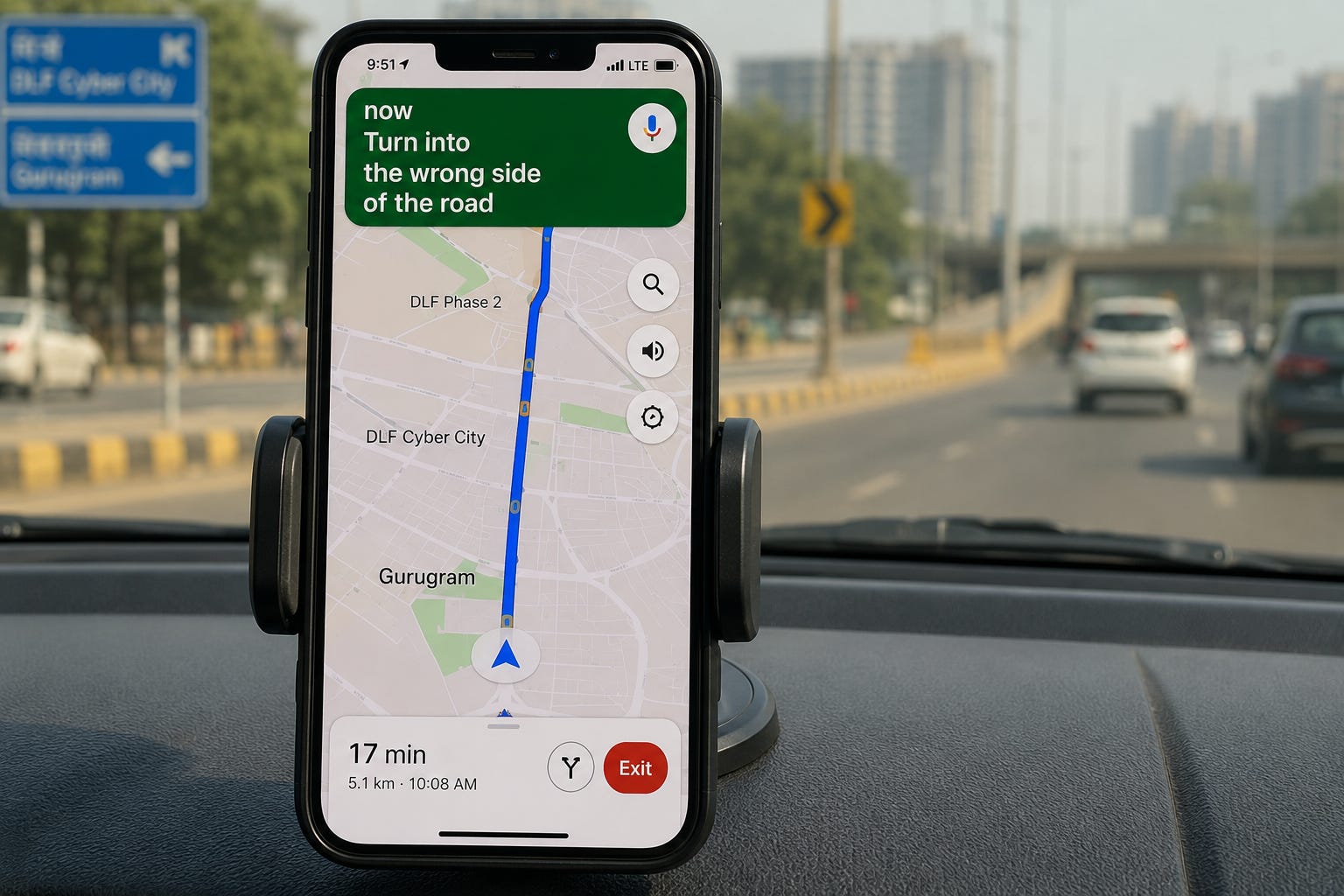
AS an Indian, my standards for public spaces are so low that what I admire in other countries is cars moving in lanes. I am also transfixed by images of Lebenese and Iranians fleeing war in their cars — in orderly lanes. I wonder if a time will ever come when Indians go to buy ice-cream in lanes. I find it odd that any two nations that drive in lanes would be at war with each other, given the grace and social intelligence they demonstrate on their streets. In Hollywood disaster films, I am unmoved by scenes where a city is trying to flee a calamity, because they look more orderly than Gurugram at any time.
I used to wonder at which precise per capita income a developing country begins to observe lane discipline. I don’t wonder anymore. I have realized there is no correlation.
In the past year alone, I have seen wrong- side driving increase by many orders of magnitude across India. This is part mystery, because cops continue to hide behind trees and lamp-posts to pounce on people who run a signal or ride without a helmet. Yet, people drive on the wrong side of the road in full public view. Not just cycles and food-delivery mopeds, or SUVs like Thars. All sorts of vehicles drive boldly on the wrong side. This makes me feel that two things have happened.
First, an informal policy has come to be that as traffic cannot be managed through administrative competence and infrastructure, people should be allowed to break some rules to defuse tension. I am more sure about the second factor, which is that India’s civil war between the city and the village is over, and the village has won decisively. By city, I mean a place that is not so serious about social order but can only function with high civic order. The village, on the other hand, is about strict social order and conducts civic life with romantic veneration for informality, short-cuts, petty practicality and human nature, which is somehow chiefly about breaking rules. This whole country is an endless village, seen that way.
There is a complex and accidental good that chaos does, a function also performed by the mofussil ugliness of Indian cities. It reassures losers of the system that India is poor, that India is a lot like them. But this aesthetic balm is like a painkiller. It makes the present bearable, but does long-term damage. It keeps all of us poor, not statistically, but where it really matters: in the way we live.
Last week, I was helping a friend get a driver’s licence and I figured that for Rs 8000 she can get a permanent licence without appearing for a test. It shows.
Even though Indians seem to talk about civic order more than ever, most urban residents don’t appear to consider it a priority in comparison with abstract, magical and cultural matters. Once, a person posted on social media his video of obstructing a biker who was defiantly on the wrong side of the road. Many commentators condemned the sanctimony of the person who made the recording. They said the country has greater problems. But it does not.
Most of our problems come from the same force that condones wrong side driving. The fire that broke out in a Delhi hotel a few days ago, killing 21, was caused by the same mindset that empowers people to take a 10-tonne vehicle out on the street, drive on the wrong side the whole day, and face no consequences, unless someone takes a video, posts it on social media and tags the police. Any officer in this country can just step out of his office, on to the road, and see wrong-side driving within five minutes, but they appear to notice it only on social media.
I was watching Wim Wenders’ Perfect Days, a marvellous film about a man who cleans toilets in Tokyo, who lives an austere and full life, whose home is small, who sleeps on a floor mattress, who needs no phone or TV, and who reads novels before he goes to sleep. The only nuisance in his life is the affection of people. The film tries to convey this is a way to be happy. It is persuasive, to men especially, but its theme is not universal. The film would make no sense if it were set in a city like Gurugram. That is because a man who cleans toilets here would have an abysmal life, not because of his profession but because the city’s public spaces are impoverished. A poor man in Tokyo can lead a better life than many Indian millionaires because of the city’s true luxury: every single city official appears to do an exemplary job everyday. An orderly city is beautiful because it means thousands of humans with high work ethic have come together to show they care for other people. A beautiful city, in my view, is the exact opposite of any Indian city.
What is the point of India spending billions on its image, like raising swanky airports? Is the idea that someone would land at such an airport, be blown away by it, and then when he is stuck in the hell hole of the Indian city, inhaling poisonous air, he is going to think how fine the airport was? What is the point of brand-building exercises when anyone who lands here can see within five minutes that things are a mess, we do not know the meaning of planning, and we are a danger to ourselves?
We have solved extreme poverty, which was the easy part. Now we have to solve the problems of prosperity. When everyone is empowered to own a vehicle and drive anyway they want, what does India do? It has no idea how to deal with it.
The absence of quality of life in India is entirely the fault of governance. Indians are under very little pressure on the roads to be orderly. The Delhi Metro has taught us a long time ago what to do — create everything that is required for a person to obey the rules, only then threaten to fine, then do fine mercilessly. If Indians can be persuaded not to spit in the Delhi Metro, any miracle can happen outside it.
(Manu Joseph is a journalist, novelist and screenwriter. His latest book is, ‘Why the Poor Don’t Kill Us’.)
Amazing observation. What I would like to add is a pretty simple thing.
Maybe I'm wrong being a foreigner. But what I observe and identify as a reason this things happen is not about education or level of income.
I see deeply rooted disrespect to unknown people around.
Anyone can throw a garbage out of car's window. Anyone can drive an opposite lane. Anyone can endlessly honk. And switch on distant light with no concern if it's unconvenient for next car driver. Stop and pee without any hesitation at any spot along the road. No single thought appears in people's mind how disrespectful this way of behavior is.
For me as a foreigner living in India for years, this disrespect is very visible. And of course it has another side. People are craving to get other ones respect. Wearing fancy brands and jewelery. Living in posh societies. Owning expensive cars. Finally having servants, maids, drivers. All this is desperate need of other people respect. But it doesn't help having your servants paid respect calling you "sir".
And of course in the society where disrespect is a natural way of human attitude one to another, simple thing as having respect of others as they drive in correct lane becomes a luxury.
How to fix it? Maybe to start respect other ones around. For each of us living in India.
I live in a tier-2 city that has, over the last 25 years, been on its way to becoming a "big city". My one observation is that while the roads are broader now and there are more traffic signals and dividers, in people's minds, they're still living in a large town rather than a big city. And that's why, when suddenly a road divider gets made, they can't process that to take their regular route now, they have to make a U-turn from 1 km ahead. And that's why they feel that it's best to just go wrong side!